

If you are a freelance photographer or videographer, you already know the harsh reality of the visual arts: the barrier to entry is paved with wildly expensive, rapidly depreciating technology. Between flagship mirrorless bodies, premium cinematic lenses, and heavy-duty lighting arrays, the capital required to stay competitive is immense.
When tax season rolls around, the most common question echoing across creative forums and production sets is a variation of the same theme: how to write off camera equipment under section 179. While "Section 179" has become a popular buzzword for a magical tax write-off, treating it as a one-size-fits-all solution is a massive compliance hazard. Navigating the federal tax code requires precision. Here is the definitive guide to capitalizing your gear, avoiding the devastating recapture trap, and keeping the IRS out of your editing bay.
The Section 179 Reality Check (2026 Updates)
Section 179 of the Internal Revenue Code (IRC § 179) allows business owners to deduct the full purchase price of qualifying equipment in the year it is placed in service, rather than slowly recovering the cost over five years via standard depreciation.
Thanks to the One Big Beautiful Bill Act (OBBBA) enacted for the 2026 tax year, the limits are historically high. The maximum Section 179 deduction is now permanently indexed at $2,560,000, with a phase-out threshold activating at $4,090,000. Additionally, OBBBA restored 100% Bonus Depreciation (IRC § 168(k)).
However, there is a strict legally binding limitation: The Business Income Limitation. You cannot use Section 179 to drive your net Schedule C business income below zero to offset a spouse's W-2 income. If you buy a $10,000 camera setup but your freelance business only netted $4,000, you can only claim $4,000 under Section 179 this year. The rest must be carried forward.
The "Listed Property" Trap and Form 4562
The IRS looks at high-end cameras and assumes they are highly likely to be used for personal vacations or weekend hobbies. Because of this, camera equipment is heavily scrutinized under the "Listed Property" designation.
To legally claim a Section 179 deduction, your gear must pass the predominant use test, meaning it is used strictly for revenue-generating business purposes more than 50% of the time. If you use a camera 80% for paid commercial shoots and 20% for personal travel, your deduction is rigidly capped at 80% of the cost.
This creates a massive administrative burden on your tax return. You cannot simply dump the cost of your gear onto the front page of IRS Form 4562. Instead, you must follow this exact flow:
- Detail the cost, business-use percentage, and elected Section 179 cost for each item in Part V (Lines 26-29) of Form 4562.
- Carry the total mathematical calculation from Part V over to Part I (Line 7).
- Once the income limits are applied, the final allowable deduction flows to Schedule C, Line 13.
The Recapture Trap: Why Section 179 is Dangerous
A deep dive into cinematography forums reveals a glaring misunderstanding of asset capitalization versus operational expenses (CAPEX vs. OPEX). As one veteran cinematographer pointed out regarding the urge to buy gear strictly for deductions: "The item still counts as an asset. So if/when you later sell it, that will count as income at the time of sale."
This is the Depreciation Recapture Trap. Cameras have a 5-year MACRS recovery period. Let's say you write off a $15,000 cinema camera under Section 179 in Year 1. In Year 3, you take a full-time corporate job and stop freelancing, dropping your business use to 0%.
Because you dropped below 50% business use before the 5 years were up, the IRS forces you to calculate the difference between your massive upfront deduction and standard depreciation. This difference becomes "phantom income" that you must report on Form 4797, Part IV. You will be hit with an immediate tax bill for a freelance business that no longer exists.
The Superior Strategy: The De Minimis Safe Harbor
Across professional tax subreddits, anxious creatives constantly ask if they should utilize Section 179 for a $1,000 camera or an $800 lens. The resounding answer from tax experts is a definitive no.
For the vast majority of your everyday gear, the De Minimis Safe Harbor (Treasury Regulation Section 1.263(a)-1(f)) is vastly superior. This election allows you to completely bypass complex depreciation and immediately expense any tangible property costing $2,500 or less per invoice.
By attaching a formal De Minimis Safe Harbor election statement to your return, you legally treat that $2,000 gimbal or $1,500 prime lens as a consumed office supply. This completely removes the asset from the Form 4562 Listed Property tracking nightmare and entirely nullifies the risk of future depreciation recapture.
Actionable Tax Tips for Visual Artists
To protect your business and optimize your cash flow, follow these strict guidelines:
- Avoid the Hobby Loss Rule (IRC § 183): Don't start a "business" just to write off gear against your day job. The IRS requires a genuine profit motive. If you don't show a net profit in three out of five years, the IRS can reclassify you as a hobby, disallow all deductions, and hit you with severe back taxes.
- Beware State Decoupling: Federal tax law does not always equal state tax law. For example, while the IRS allows a $2.56 million Section 179 limit, California rigidly caps its state-level deduction at a mere $25,000 and completely disallows Bonus Depreciation.
- Never Convert Pre-Business Gear: You cannot use Section 179 on a camera you owned personally before officially launching your business. Converted assets must be depreciated slowly based on their lower fair market value.
- Understand Vehicle Classifications: If you buy a heavy production cargo van (over 14,000 lbs GVWR) with no rear passenger seating, it is exempt from Section 280F luxury auto limits and qualifies for 100% expensing. Standard SUVs under 6,000 lbs are severely restricted.
Eliminate the Administrative Nightmare with Receipt Scan
As a seasoned full-stack developer who has spent years in the freelance trenches, I watched entirely too many brilliant creatives lose billable hours sweating over spreadsheets, terrified of triggering a desk audit over an undocumented $800 audio interface. The constant anxiety over what falls under the Safe Harbor versus what needs to be manually entered on Form 4562 Part V is an administrative bottleneck that kills creativity.
That is exactly why I engineered Receipt Scan.
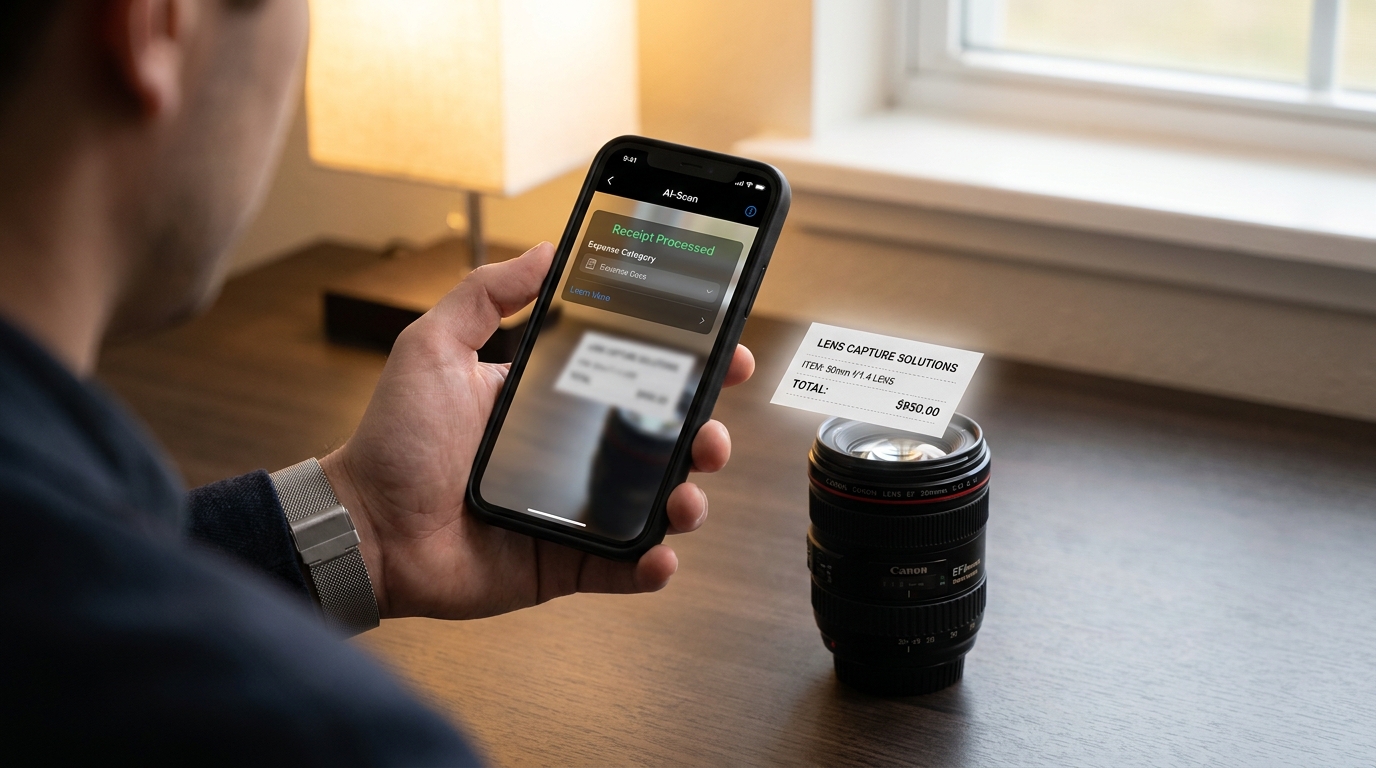
Receipt Scan is an AI-powered SaaS platform built specifically to eliminate manual data entry and fortify your tax compliance. Instead of shoving faded equipment invoices into a shoebox, you simply scan them. The platform’s backend architecture instantly categorizes the data, intelligently flagging items under $2,500 for your De Minimis Safe Harbor election while organizing high-ticket capital assets for your CPA to review for Section 179.
It is not just an expense tracker; it is a dedicated workflow upgrade designed to align seamlessly with your Schedule C requirements. By maintaining an audit-proof, digitized paper trail of your purchase dates and exact costs, Receipt Scan buys back your time—so you can stop worrying about beating the tax code and get back to focusing on the frame.